Winner, 2025 Outstanding Book Award, Division of International Criminology, American Society of Criminology
Abstract
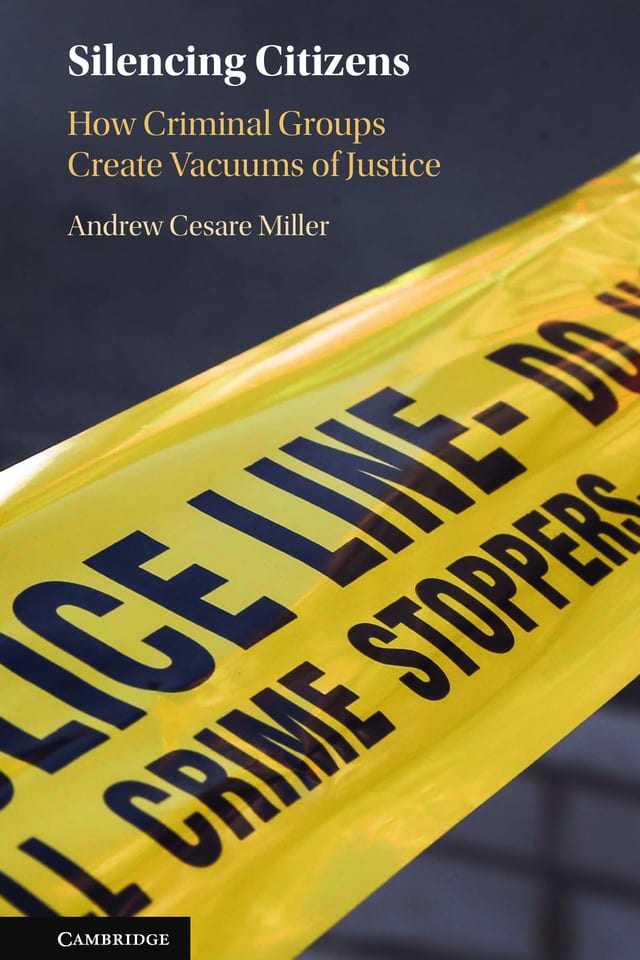
Criminal groups, like mafias and gangs, often get away with murder. States are responsible for providing justice but struggle to end this impunity, in part because these groups prevent witnesses from coming forward with information. Silencing Citizens explains how criminal groups constrain cooperation with the police not just by threatening retaliation but also by shaping citizens’ perceptions of community support for cooperation. The book details a social psychological process through which criminal group violence makes community support for cooperation appear weaker than it is and thus reduces witnesses’ willingness to share information with the police. The book draws on a wealth of data including original surveys in two contrasting cities: Baltimore, Maryland in the Global North and Lagos, Nigeria in the Global South.
States frequently conduct covert action, such as attempting to subvert or overthrow their rivals. When doing so, intervening states may deploy their own operatives or cooperate with proxy actors, including criminal organizations. Under what conditions do interveners use criminals for covert action? Existing works have highlighted the potential benefits to interveners of working with criminal organizations but do not explain why states use them in some cases and not in others. We theorize that interveners are more likely to employ criminals in covert action when (1) criminal organizations have unique access to the target—meaning criminals have the will and wherewithal to carry out an operation undetected, whereas interveners’ other proxies do not—and (2) when a criminal organization calculates that the material benefits of cooperation with the intervener outweighs the risks. To probe the importance of these factors, we examine two contrasting cases: the US’ use of the Italian-American mafia in an attempt to assassinate Cuba’s Fidel Castro and Libya’s 1986 negotiations with the Chicago-based El Rukn gang to conduct a terrorist attack in the US. We pair each of these core cases with a similar case in which interveners possessed other avenues for accessing the target, namely the US-backed overthrow of Rafael Trujillo in the Dominican Republic and a Libyan-sponsored bombing in West Berlin. By highlighting the significance of unique access to the target and criminal organizations’ own calculations regarding cooperation, this article introduces a dynamic theory accounting for states’ use of criminal organizations in covert action.
Many states struggle to provide justice for victims of violent crime, partly due to criminal groups preventing citizens from sharing information with the police. Cycles of silence theory posits that criminal groups constrain witness information-sharing by making community norms favoring cooperation with the police appear weaker to citizens than they are. This article tests the theory in the markets of Lagos, Nigeria, where shopkeepers are exposed to violence by “area boy” crews. According to survey results, shopkeepers perceive that fewer witnesses would share information with the police than are willing to do so, and as a result, the average witness is predicted to share significantly less information than they would have if they were aware of the latent strength of cooperation norms. A virtual reality vignette embedded in the survey shows that rendering a crime reporting tip line anonymous and creating awareness of other shopkeepers cooperating can increase witness information-sharing.
How can political scientists rigorously evaluate the predictive power of theories? Many peer-reviewed political science articles include predictions about future outcomes, and scholars make predictions on social media and other public forums. The prevalence of predictions suggests that scholars recognize the utility of leveraging theories for this purpose; however, the predictions often are not made in a manner that allows for rigorously evaluating their accuracy. Building on the increasing popularity of study preregistration in the social sciences, this article proposes “prediction registration” as a means for scholars to publish falsifiable, systematic, and verifiable theory-based predictions. Increasing the rigor of predictive theory testing can advance often-circular debates about accuracy and presents a “win-win” for scholars who aim to test the predictive power of theories. With a more rigorous approach, correct predictions would better demonstrate a theory’s ability to forecast outcomes, and missed predictions would reveal information that can be used to calibrate the theory.
What are the dangers of states using criminal groups for national defense? This article evaluates this question in the context of Ukraine’s response to the 2022 Russian invasion. It lays out what is currently known about Kyiv’s use of criminal groups as part of its defense efforts, specifically for intelligence-gathering and for bolstering military manpower. Wartime arrangements with criminal actors, however, could compound corruption concerns among citizens that undermine their trust in the state. Such arrangements might entrench a pre-war perception that criminal groups wield influence over state institutions. The state granting leniency to criminal actors in exchange for wartime support could also reduce already low confidence in Ukraine’s criminal justice system. While leveraging criminal groups may be necessary for defense purposes, Ukrainian authorities should remain cognizant of the trade-offs involved—some of which may not become evident until the post-war period.
Do International Criminal Court (ICC) indictments reduce atrocities? The ICC convicting only ten perpetrators since its founding in 2002 has generated skepticism of the court’s ability to prevent attacks against civilians. Drawing on the criminal violence literature, this article applies the concept of assurance to explain how the ICC reduces atrocities despite its limited capacity. As with criminal organizations facing domestic indictments, armed groups affiliated with ICC indictees often (mis)perceive that the indictments come with assurance: that is, indictee-affiliated groups believe that they can alleviate the costs imposed by indictments if they refrain from further attacks. I test the effect of ICC indictments on violence using the weighted regression method generalized synthetic control to mitigate empirical challenges posed by endogeneity and data unreliability. The results indicate that indictments lead to a substantial initial decline in attacks against civilians by armed groups affiliated with indictees, but the attacks return to pre-indictment levels when indictees face sustained punishment from the court. Descriptive cases of ICC indictments against alleged perpetrators in Uganda and Kenya are used to illustrate the role of assurance. These findings imply that the ICC might reduce violence by engaging in plea bargains and other negotiated settlements—tools commonly employed by domestic prosecutors fighting criminal organizations.
Can authorities effectively shut down widely used social media platforms? This article theorizes that banning social media platforms with existing user bases triggers the psychological mechanism of reactance. Reactance motivates citizens to circumvent bans and ultimately results in intensified criticism of the censoring authorities on banned platforms. Reactance dynamics in response to social media bans are particularly relevant in countries with hybrid regimes—that is, regimes with both democratic and autocratic characteristics. Authorities in these countries generally allow widespread adoption of social media platforms. At the same time, they engage in temporary platform bans, usually to limit antiregime discourse at crucial political junctures such as elections. This combination of large user bases and temporary bans creates a “reactance equilibrium” in which there is high demand among citizens to access the restricted platforms. Unlike with censorship of traditional media such as television and print news outlets, the costs for citizens to circumvent social media bans are relatively low, which allows citizens to act on their reactance states. Drawing on a dataset of 15 million geolocated tweets, this article presents evidence of a censorship backlash to Turkey’s March 2014 Twitter ban, which is considered among the first attempts to block a widely adopted social media platform. A synthetic control model and descriptive statistics reveal widespread circumvention of the ban. Furthermore, sentiment analysis shows that, in the wake of the ban, Twitter discourse became increasingly negative, especially toward the ban’s main progenitor then-Prime Minister Recep Tayyip Erdogan.
In the past decade, political violence research has been deeply shaped by the “ethnopolitical exclusion” model of conflict, a research tradition that emphasizes the group-level mechanisms connecting ethnic identity to conflict processes. This review article examines three recent books that represent a new wave of scholarship that studies how different social, political, and institutional processes give rise to ethnically-organized violence. These works make several notable contributions. They move beyond static, structuralist approaches for understanding the emergence of ethnic “grievances” and focus attention on the dynamic processes and state policies that amplify or curb the political salience of ethnic appeals. They also shed new light on the nuanced role that ethnic demographic distributions play in the onset and termination of intrastate conflict.
Seminal contributions to the study of nation-building emphasized the role of newspapers in the development of national consciousness. But do such theories apply in the modern context of online news sites, especially in diverse, postcolonial societies? Because online news sites contain forums for reader comments, this provides an opportunity to assess the relationship between exposure to media content and citizen sentiments. We investigate the extent to which a major online news site makes ethnic categories salient in sub-Saharan Africa’s largest country, Nigeria. Analysing more than 35,000 news articles and 300,000 comments, we find that commenters frequently broadcast strong expressions of subnational ethnic animus in response to a wide variety of stories. In particular, the use of some ethnic categories in headlines is associated with more than 40 percentage point increase in the probability of at least one reader making an ethnic-based comment. Extending the analysis to South Africa, we show that these patterns generalize beyond Nigeria. By amplifying ethnic animus, ‘national’ newspapers may impede nation-building efforts.
In response to the recent coup in Niger, which ousted the country’s president-turned-strongman Mamadou Tandja, the capital erupted in pro-coup demonstrations. Many commentators and foreign governments also showed tacit support for the junta. What is the likelihood that this coup and the other coup regimes in Africa will lead to the institutionalization of durable and stable democracies? Based on historical analysis of past African coups that brought brief democratic transitions, this article argues that it is unlikely. For the four African coups that briefly put in place democratic institutions—Sierra Leone (1968), Ghana (1978), Sudan (1985), and Niger (1999)—the juntas and proceeding civilian governments failed to address core political and economic issues, lacked durability, and did not engender long-term political stability. To further debunk the myth of the so-called “good” coup d’état in Africa, this article also demonstrates that coup regimes, which consolidate governing authority in failed states, attempt to institutionalize autocracies.
Book Chapters
Miller, Andrew Cesare. 2026. “Center City Strategy Game.” In Short Games and Active Learning in Political Science: Beating the Clock, eds. Derek Glasgow, Mark Harvey, Ryan Gibb, and James Fielder. New York: Routledge.
Abstract
This strategy game helps students understand the strategies that state and non-state actors employ to compete for control of territory. It does so in the context of an urban environment where police, criminal groups, and vigilantes often vie for control of neighborhoods. These dynamics relate to broader topics in comparative politics including criminal governance and conflict processes, among others.
Blair, Graeme, Fotini Christia, Andrew Cesare Miller, and Jeremy M. Weinstein. 2024. “Understanding Community Policing.” In Crime, Insecurity, and Community Policing: Experiments on Building Trust, eds. Graeme Blair, Fotini Christia, and Jeremy M. Weinstein. New York: Cambridge University Press.
Abstract
This chapter lays out the theoretical foundations of community policing and highlights evidence gaps in evaluations of community policing’s effectiveness. Community policing is a law enforcement strategy that centers around building trust between police and citizens as well as promoting citizen engagement with authorities in order to advance public safety. The chapter describes the origins of community policing as well as the logic of how it might render the police more effective, primarily through improved information provision from citizens. Despite substantial support for community policing, a systematic review detailed in the chapter reveals significant evidence gaps in evaluations of the effectiveness of community policing interventions such as beat patrols and the police engaging in town hall meetings. The review finds that the evidence gaps are particularly acute with respect to evaluations in Global South communities.
We are interested in developing a data-driven method to evaluate race-induced biases in law enforcement systems. While recent works have addressed this question in the context of police-civilian interactions using police stop data, they have two key limitations. First, bias can only be properly quantified if true criminality is accounted for in addition to race, but it is absent in prior works. Second, law enforcement systems are multi-stage and hence it is important to isolate the true source of bias within the “causal chain of interactions” rather than simply focusing on the end outcome; this can help guide reforms. In this work, we address these challenges by presenting a multi-stage causal framework incorporating criminality. We provide a theoretical characterization and an associated data-driven method to evaluate (a) the presence of any form of racial bias, and (b) if so, the primary source of such a bias in terms of race and criminality. Our framework identifies three canonical scenarios with distinct characteristics: in settings like (1) airport security, the primary source of observed bias against a race is likely to be bias in law enforcement against innocents of that race; (2) AI-empowered policing, the primary source of observed bias against a race is likely to be bias in law enforcement against criminals of that race; and (3) police-civilian interaction, the primary source of observed bias against a race could be bias in law enforcement against that race or bias from the general public in reporting (e.g. via 911 calls) against the other race. Through an extensive empirical study using police-civilian interaction (stop) data and 911 call data, we find an instance of such a counter-intuitive phenomenon: in New Orleans, the observed bias is against the majority race and the likely reason for it is the over-reporting (via 911 calls) of incidents involving the minority race by the general public.